Heads up: this post contains affiliate links, which cost you nothing extra. As an Amazon Associate I earn from qualifying purchases.
Most pumpkin math printables are a coloring page with a number on it. The kids enjoy them, and nobody learns much.
These fifteen are different. Each one teaches one specific skill, and each one uses a real pumpkin, a bag of foam ones, or things already sitting in a classroom or a kitchen drawer. They are sorted by grade band, kindergarten through fifth, so you can find your students and start.
I am a former math teacher and principal, so the activities near the end lean on multiplication. That is on purpose.
Free for your classroom or kitchen table
Want the pumpkin arrays already printed?
The free Fall Math Pack has three pumpkin array pages, from small patches to giant ones you split in two, plus an apple orchard multiplication maze and a Fall Facts bingo set with caller cards for all 36 facts. Twelve pages, and they print fine in black and white. Enter your email and the download link appears right away.
What you need
Nothing here requires a special kit. A few things make it easier, especially with a whole class.
- Pumpkins. One real pumpkin for the seed activities, and a bag of small foam pumpkins for everything else. Foam ones last all month and do not rot on the windowsill. Shop small artificial pumpkins on Amazon
- Counters. Fall mini erasers make good counters for ten frames and arrays. Shop fall mini erasers on Amazon
- Linking cubes, for measuring and building arrays. Shop linking cubes on Amazon
- A soft measuring tape and a kitchen scale. Shop soft measuring tapes on Amazon and digital kitchen scales
- Two dice for each pair of students. Foam dice are quieter. Shop foam dice on Amazon
- Small paper cups for grouping seeds by tens. Shop 3 oz paper cups on Amazon
Kindergarten and first grade: counting and comparing
1. Line them up
Set out five pumpkins of different sizes and have students put them in order, smallest to biggest. Then ask the questions that build the vocabulary: which one is first, which one is third, which one is bigger than the second one but smaller than the fourth. Ordering comes before measuring, and it is easy to skip.
2. How many cubes tall?
Stack linking cubes next to a pumpkin until the tower reaches the top of the stem. Record the number, then do it again with a different pumpkin. This is measuring with a unit, which is the whole idea behind a ruler, before anyone hands them a ruler.
3. Pumpkin ten frames
Give each student a ten frame and a handful of erasers. Call out a number from one to ten; they build it, then tell you how many more make ten. Seven and three. Six and four. Those pairs carry students through addition, subtraction, and a good part of multiplication.
4. Roll and cover
Draw a big pumpkin on paper and write the numbers 2 through 12 inside it. Partners take turns rolling two dice, adding, and covering the sum with an eraser. After a few rounds, ask why 7 keeps getting covered and 2 almost never does. That question is the start of probability.
5. Count the seeds by tens
Scoop the seeds out of one real pumpkin, rinse them, and let them dry on paper towels. Before anyone counts, everyone writes down a guess. Then count the seeds into small cups, ten per cup. Counting a big pile by ones is slow and easy to lose. Counting it by tens is place value.
Second and third grade: measuring, data, and arrays
6. Around the middle
Wrap a piece of string around the widest part of the pumpkin, mark it, and lay the string flat along a ruler or a soft measuring tape. That number is the circumference. Now measure how tall the pumpkin is and ask whether it is taller than it is around. Have everyone guess first. The string settles it.
7. Heavier or lighter
Line up three pumpkins and have students predict their order from lightest to heaviest just by looking. Then weigh each one on a kitchen scale and compare the real order to the prediction. Bigger usually means heavier; however, slip one large foam pumpkin into the lineup and watch what happens to the predictions.
8. Count the lines, make a line plot
Pumpkins have lines running from the stem to the bottom. Give each group a pumpkin to count, then put every group’s count on one class line plot. The class ends up with data it collected itself and a real question to answer: which number of lines is most common?
9. Seeds by the hundred
Take the cups of ten from activity 5 and put ten cups together. That group is a hundred. If the class counted 346 seeds, write it as 300 + 40 + 6. That is place value that came out of a pumpkin.
10. Pumpkin patch arrays
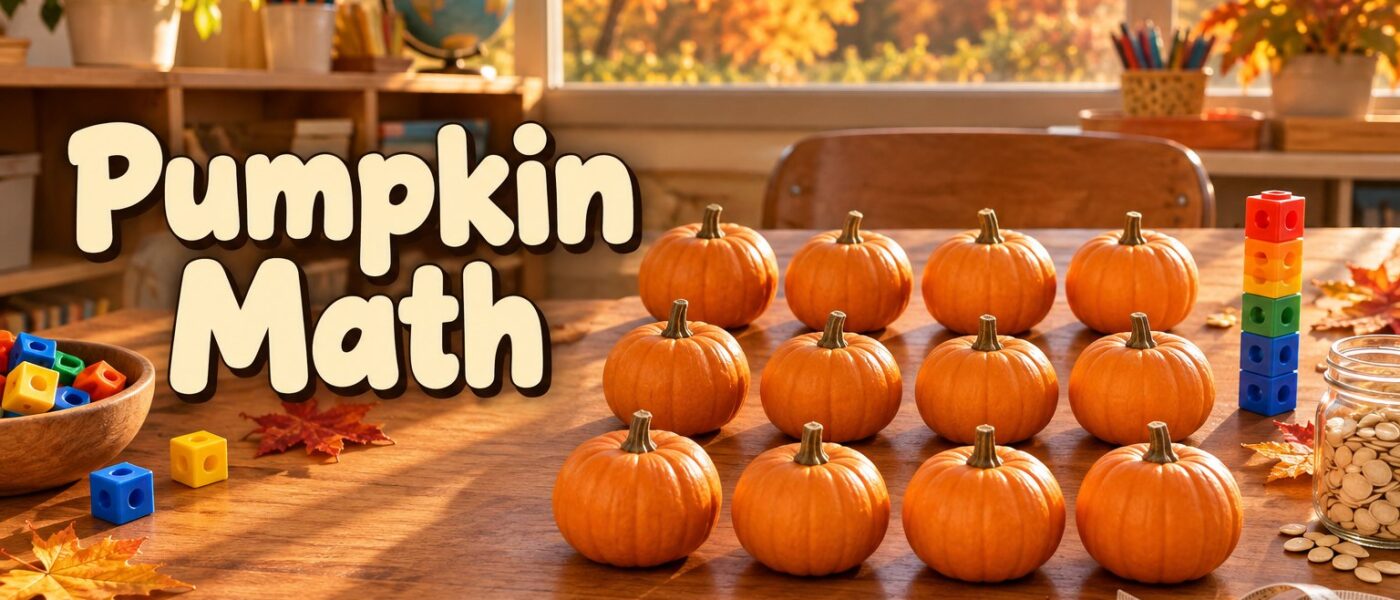
Set out erasers or foam pumpkins in rows: three rows of four. How many? Twelve. Now turn the paper sideways. Four rows of three, and still twelve. That is the commutative property, and once students see it, they have roughly half as many facts to learn. It is the same idea TimeTable Express is built on.
Third through fifth grade: multiplying, dividing, and fractions
11. Scoops times seeds
Once the seeds are dry, scoop them with a measuring cup. Count the seeds in one full scoop, scraped flat across the top, then count how many scoops the whole pile fills. Multiply for an estimate of the total. Then count the whole pile and see how close the estimate came.
12. Break apart a big patch
Draw a pumpkin patch 7 rows by 9. Instead of counting 63 squares, draw a line after the fifth column. Now it is a 7 by 5 patch and a 7 by 4 patch: 35 plus 28 is 63. Breaking a hard fact into two easier ones is how students get 7 × 9 without memorizing it cold, and it is exactly what the Giant Patches page in the Fall Math Pack practices.
13. Farm stand shopping
Post a price list: small pumpkins $4, medium $7, large $9. Hand out play money and a budget of $20. What can you buy? Two small and one large is $17, with $3 in change. Three medium is $21, a dollar too much. Every answer is a multiplication problem followed by an addition or subtraction problem.
14. Pumpkin pie fractions
Cut a paper pie, or a real one if you are brave, into eight slices. Take two away: what fraction is gone? Two eighths, which is also one fourth. Take four away and it is four eighths, which is one half. Fraction circles let every student do this at their desk without the crumbs.
Shop fraction circles on Amazon
15. Share the seeds
Count out 48 seeds and share them among 6 friends. Each friend gets 8. That is 6 × 8 = 48 run backward, and 6 × 8 is one of the hardest facts in the whole set. Then try 50 seeds among 6 friends: 8 each, with 2 left over. Remainders make sense when they are seeds on a table.
A math teacher’s note
Notice where the multiplication showed up: arrays, breaking apart, price lists, and sharing. None of it is a worksheet, and all of it is the same idea. The Multiplication Hustle starts with the hardest facts, 9 × 9 at the summit, because those are the ones that hold students back. If you want to see where your class stands this fall, our free play-along video runs all 36 facts from the summit down in about three and a half minutes.
More for fall
Hosting a trunk at church or school? 20 Trunk or Treat Ideas That Won’t Take Over Your Whole Weekend has a multiplication ring toss and an estimation jar that fit right alongside these.
Dressing up for Book Character Day? Start with 20 Easy DIY Book Character Costumes for Teachers (2026), and for the kids, 20 Eye-Catching Costumes for October.
TimeTable Express
One more thing before you start scooping.
Pumpkin math makes for a good week. The hard part is that multiplication facts do not wait for the season to end, and a student who is shaky on them in October tends to be further behind by January.
That is why we built TimeTable Express. It starts at the summit with 9 × 9 and uses the commutative property, so students learn roughly half as many facts to know all of them. A few minutes a day is plenty. It runs on iPhone or iPad, and it is free to try for 7 days.
Try TimeTable Express free for 7 days
The free Fall Math Pack is at the top of this post.