Heads up: this post contains affiliate links, which cost you nothing extra. As an Amazon Associate I earn from qualifying purchases.
Every December, gift buyers run into the same problem. You want something that teaches, and you do not want to hand a child something that feels like homework on Christmas morning.
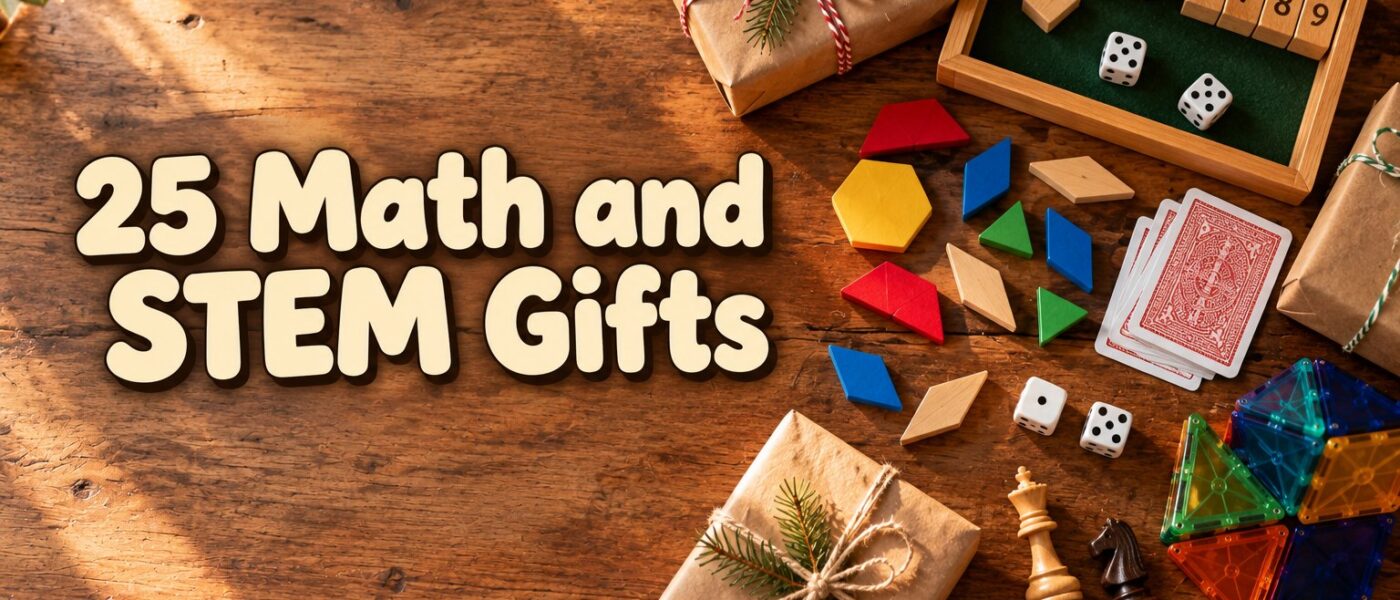
Those two goals are not at odds. The best math gifts are games and building sets where the math sits inside the fun, so a child practices without noticing. Every pick below does that, sorted by age band from 6 to 12, with the skill each one builds and one honest drawback.
How we picked these
I am a former math teacher and principal, so we were strict. Every gift on this list had to pass four tests.
- It gets played more than once. A gift that comes out on December 25 and goes to the closet on December 26 teaches nothing.
- The math is inside the game. Nothing here is a worksheet with a ribbon on it.
- A grown-up can learn it in one sitting. If the rules take an evening, the box stays closed.
- It works without a screen. Every pick below runs on cards, dice, tiles, or batteries.
Each one comes with a drawback, because every gift has one. You should know it before you buy.
Quick picks
- Best overall: Snap Circuits Jr., a real electronics kit with no soldering
- Best small gift: SET, the card game, which fits in a stocking and works for ages 8 to adult
- Best for a kid who says they hate math: Sleeping Queens, where the math is a way to win, not the point
- Best for two kids together: Blokus, which plays two to four
- Best for the whole family: Catan, a strategy game that runs on probability
Free for your classroom or kitchen table
Want something to do while the gifts are still wrapped?
The free Fall Math Pack has three pumpkin array pages, an apple orchard multiplication maze, and a Fall Facts bingo set with caller cards for all 36 facts. Twelve pages, and they print fine in black and white. Enter your email and the download link appears right away.
Ages 6 and 7: counting, shapes, and first logic
1. Magnetic tiles
Flat squares and triangles with magnets in the edges, so they snap into walls, boxes, and towers. A child who builds a cube out of six squares is learning what a face is, and one who turns two triangles into a square is doing early fractions. Skill: geometry and 3D shapes. Drawback: the sets add up fast once a child wants more pieces.
2. Pattern blocks with activity cards
Six wooden shapes in six colors. The yellow hexagon is the whole lesson: it takes two red trapezoids, three blue rhombuses, or six green triangles to cover it. That is halves, thirds, and sixths before anyone writes a fraction. Skill: fractions and shape. Drawback: bigger sets run to a few hundred small pieces that scatter, so plan on a bin with a lid.
3. Tangram puzzles
Seven flat pieces (two large triangles, one medium, two small, a square, and a parallelogram) that combine into hundreds of pictures. The cards show only the outline, so the child has to turn and flip pieces until they fit. Skill: spatial reasoning. Drawback: the hard cards frustrate younger children, so start with the ones that show the piece lines.
Shop tangram puzzles on Amazon
4. Rush Hour Junior
A traffic jam on a small grid. Slide the cars and trucks out of the way until the ice cream truck can drive out. Each card is harder than the one before, and the only way through is to think a few moves ahead. Skill: planning and sequential logic. Drawback: it is a one-player game, so it will not fill a family game night.
Shop Rush Hour Junior on Amazon
5. Shut the Box
Wooden tiles numbered 1 to 9. Roll two dice, then flip down any tiles that add up to the roll. Roll an 8 and you can close the 8, or the 5 and 3, or the 6 and 2. Children start seeing all the ways to make a number without being asked. Skill: addition facts and number combinations. Drawback: it is loud on a hard table.
6. Dominoes
A double-six set has 28 tiles, and every match is a small addition problem. Count the dots at both open ends, and you are adding. Older children can try the harder question: how many dots are in the whole set? The answer is 168. Skill: counting, matching, and addition. Drawback: the full scoring rules are a lot for a 6-year-old, so start by matching ends and building a long line.
7. A toy cash register with play money
Ring up a sale, count the money, and make change. The drawer and the buttons are the fun part, and every purchase is a subtraction problem in disguise. Skill: money, place value, and subtraction. Drawback: most need batteries, and the coins go missing faster than the bills.
Shop toy cash registers on Amazon
8. Code and Go Robot Mouse
Press the arrow buttons on the mouse’s back to program its path, then build a maze and see whether it reaches the cheese. When it misses, the child has to find the wrong step and fix it. That is debugging. Skill: sequencing, directions, and early coding. Drawback: it needs batteries and a smooth floor or table.
Shop the Code and Go Robot Mouse on Amazon
Ages 8 and 9: facts, strategy, and building
9. Snap Circuits Jr.
Parts snap onto a plastic grid to build working circuits: a fan that flies off, a light, an alarm. The manual walks through more than 100 projects with no soldering and no tools. Skill: circuits, cause and effect, and following a diagram. Drawback: it runs on AA batteries, so check whether they come in the box.
Shop Snap Circuits Jr. on Amazon
10. Gravity Maze
Build a tower from translucent pieces so a marble dropped at the top lands on the target at the bottom. Each challenge card gives you a few pieces and a goal; the rest is trial, error, and seeing in three dimensions. Skill: spatial reasoning and planning. Drawback: it is mostly a solo game.
11. Sleeping Queens
A card game where you wake up queens to win. One way to play a turn is to discard cards that make an addition equation, like 2, 3, and 5. Children start hunting for equations in their hand because it helps them win. Skill: addition and quick strategy. Drawback: luck plays a big part, so the best player does not always win.
Shop Sleeping Queens on Amazon
12. Math Dice
Roll two 12-sided dice and multiply them to get a target number. Then roll three regular dice and use any operation to get as close to the target as you can. It is the closest thing on this list to straight multiplication practice, and it still plays like a game. Skill: multiplication, mental math, and order of operations. Drawback: a child who is not yet solid on the facts will struggle early; play with them the first few times.
13. Yahtzee
Five dice, three rolls, and a scorecard. The top of the card is multiplication: three 4s score 12, and four 5s score 20. The bottom half adds probability, because a child has to decide whether to chase a large straight or take the sure points. Skill: multiplication, addition, and probability. Drawback: a full game takes a while for young players.
14. Kanoodle
A pocket-sized puzzle where you fit oddly shaped pieces into a tray to match a starting layout from the booklet. It travels well and runs quietly, which matters on a long drive. Skill: spatial reasoning. Drawback: the pieces are small and easy to lose.
15. Spirograph
Gears roll inside rings to draw looping patterns. The math is hiding in the teeth: a 96-tooth ring with a 36-tooth wheel draws 8 loops, because 96 divided by the largest number that goes into both (12) is 8. A child does not need to know that to enjoy it; however, it makes a great question once they do. Skill: patterns, geometry, and factors. Drawback: the pen slips when the wheel is pushed too hard, so expect some false starts.
16. Blokus
Each player gets 21 pieces made of one to five squares. Your pieces can touch only at the corners, and the goal is to fit as many on the board as you can. It is easy to teach and quick to set up. Skill: spatial strategy and planning ahead. Drawback: with two players, each person runs two colors, which takes a game to get used to.
Ages 10 to 12: probability, patterns, and engineering
17. SET
Each of the 81 cards has four features: number, shape, shading, and color. A set is three cards where each feature is either all the same or all different. Everyone looks at the same twelve cards and races to call a set first. Skill: logic and pattern recognition. Drawback: quick players can run away with it, so some families play it cooperatively at first.
18. Laser Maze
Place mirrors and splitters on a grid so a real laser beam hits the targets on each challenge card. Children predict the path, test it, and adjust. Skill: angles, reflection, and logic. Drawback: it is a one-player game.
19. Catan
Players build roads and settlements on a board of number tiles, and each turn two dice decide which tiles pay out. Seven comes up most often (6 of the 36 possible rolls), but no tile carries a 7. Of the numbers on the board, 6 and 8 come up most (5 rolls each) and 2 and 12 least (1 each). Players who understand that place their settlements better. Skill: probability, trading, and planning. Drawback: a full game can run over an hour.
20. Ticket to Ride
Collect train cards, claim routes across a map, and connect the cities on your secret tickets. Longer routes score more points than the trains they use, so every turn is a small decision about cost and payoff. Skill: planning, addition, and geography. Drawback: the scoring at the end takes careful counting, and a grown-up should run it the first time.
21. A cribbage board and a deck of cards
One of the oldest games on this list, and maybe the best one for mental math. Players count every combination that makes 15, count pairs and runs, and keep a running total that cannot pass 31. Skill: fast addition and combinations. Drawback: the scoring rules take a grown-up who knows the game, or a good video, to teach.
Shop cribbage boards on Amazon
22. A chess set
Sixty-four squares and a lifetime of thinking ahead. Chess builds the habit of asking “if I do this, what happens next,” which is the same habit a multistep word problem needs. Skill: logic, planning, and patience. Drawback: losing over and over early on wears children down, so play a few easy games first.
23. A Rubik’s Cube
A 3 by 3 cube has about 43 quintillion possible positions, and there is still a step-by-step method that solves it from any of them. Learning that method is learning an algorithm. Skill: algorithms, memory, and spatial reasoning. Drawback: most children need a tutorial to solve it the first time.
24. LEGO Technic
Gears, axles, and beams instead of regular bricks. A 24-tooth gear turning an 8-tooth gear spins it three times for every one turn, which is a ratio a child can watch happen. Skill: gear ratios, mechanics, and following a build diagram. Drawback: the bigger sets cost more than most gifts on this list.
25. A K’NEX roller coaster
Build a working coaster and test the hills and loops with a real car. When the car stalls, the child has to work out why: too steep, too tall, too little speed. Skill: physics, measurement, and problem solving. Drawback: a finished coaster takes up real floor space and a long afternoon to build.
Shop K’NEX roller coasters on Amazon
What we would not buy
Three kinds of “educational” gifts we skip.
- A workbook wrapped as a present. Workbooks have their place. Christmas morning is not it.
- A kit that builds one thing once. If it goes on a shelf after the first afternoon, the learning ends there too.
- A toy that does nothing without an app. When the app stops working or the tablet is needed for something else, the toy is done.
The gift that makes the rest stick
Every game above builds number sense. However, a child who does not know the multiplication facts will still slow down on every one of them, from Math Dice to the Yahtzee scorecard to Catan.
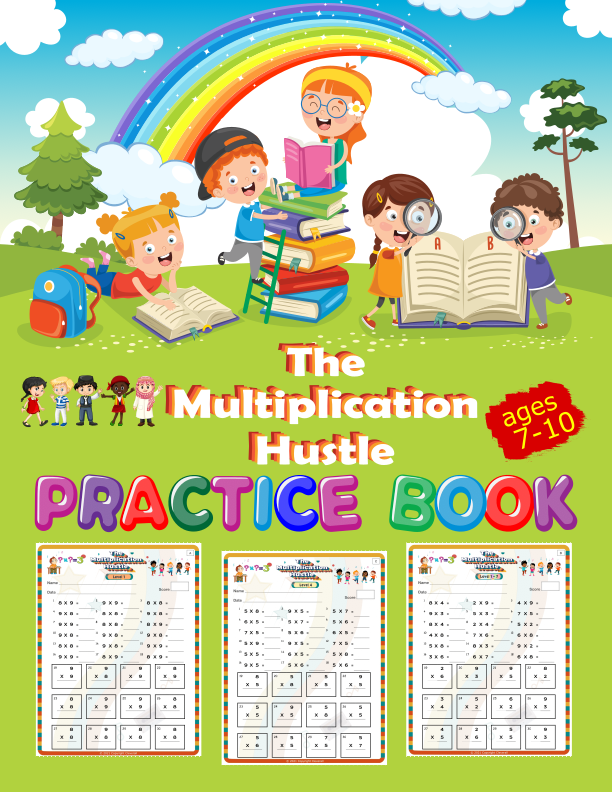
The Multiplication Hustle starts with the hardest facts, 9 × 9 at the summit, because those are the ones that hold students back. If you want to see where your child stands, our free play-along video runs all 36 facts from the summit down in about three and a half minutes.
More from us
Want the same idea for the classroom this fall? Pumpkin Math: 15 Activities That Actually Teach Something uses supplies you already have. For more building gifts for ages 8 to 12, see Discover the Best Robotics Kits for Kids Ages 8-12. And if you are weighing math apps, start with What Is the Best App for Learning Multiplication Tables.
TimeTable Express
One more thing before you check out.
Games build number sense. The hard part is that multiplication facts do not wait for the holidays to end, and a student who is shaky on them in November tends to be further behind by January.
That is why we built TimeTable Express. It starts at the summit with 9 × 9 and uses the commutative property, so students learn roughly half as many facts to know all of them. A few minutes a day is plenty. It runs on iPhone, iPad, or Android, and it is free to try for 7 days, then $5.99 a month or $19.99 a year.
Try it free on the App StoreTry it free on Google Play
The free Fall Math Pack is at the top of this post.