Heads up: this post contains affiliate links, which cost you nothing extra. As an Amazon Associate I earn from qualifying purchases.
The weeks before Thanksgiving break are hard to teach. Everyone is thinking about the long weekend, and a regular worksheet does not stand much of a chance.
These activities use what is already on everyone’s mind: being thankful, the food, and who is coming to dinner. There are three gratitude activities, three graphing activities, and a set of ten turkey word problems with an answer key. They run from kindergarten through fifth grade, and most of them need nothing more than sticky notes, paper, and a pencil.
I am a former math teacher and principal, so the word problems lean on multiplication. That is on purpose.
Free for your classroom or kitchen table
Want these ready to print?
The free Thanksgiving Math Pack has the thankful graph, tally chart, and gratitude chain strips ready to copy, plus a pie slices page, a favorite food pictograph, eight more turkey word problems, a feast shopping list, a coordinate grid turkey, and all 36 facts from the summit down. Twelve pages with an answer key, and they print fine in black and white. Enter your email and the download link appears right away.
What you need
Nothing here requires a special kit. A few things make it easier with a whole class.
- Sticky notes, one or two per student for the graphs. Shop sticky notes on Amazon
- Chart paper, so the class graph can stay on the wall all week. Shop chart paper on Amazon
- Paper strips for the gratitude chain. Shop paper chain strips on Amazon
- Graph paper and, if you have them, coordinate grid boards for the turkey design. Shop graph paper on Amazon and coordinate grid dry erase boards
- Counters. Fall mini erasers work for the pictograph and the word problems. Shop fall mini erasers on Amazon
- Play money for word problem 9. Shop play money on Amazon
Gratitude: counting what we are thankful for
1. The thankful graph (kindergarten to second grade)
Give every student a sticky note and ask them to draw or write one thing they are thankful for. Then sort the notes into four columns on chart paper: people, pets and animals, food, and places or things. Stack the notes neatly and the class has built a bar graph without anyone calling it one. Ask which column is tallest, which is shortest, and how many more notes are in the tallest column than the shortest.
Shop fall leaf cutouts on Amazon if you want the notes to look like leaves on a tree instead.
2. Tally the week (first to third grade)
Every morning for a week, each student adds one tally mark to the class chart for something they are thankful for that day. Cross every fifth mark the usual way. On Friday, count the groups by fives and add the extras: seven groups of five and three extra marks is 35 plus 3, or 38. Tally marks are skip counting in disguise, and skip counting is where multiplication starts.
3. The gratitude chain (second to fourth grade)
Each paper strip holds one thing someone is thankful for, and each strip becomes a link in a chain. When the chain has ten links, measure it. Then ask the question that makes it math: if ten links are that long, how long will one hundred links be? Multiply by ten, write the estimate on the board, and check it when the chain gets there.
Graphing: the food and the table
4. Favorite food survey (second and third grade)
Ask every student to vote for one favorite Thanksgiving food. Say a class of 30 votes like this: pie 10, turkey 8, mashed potatoes 6, stuffing 4, and rolls 2. Make a pictograph where each picture stands for 2 votes. Pie gets 5 pictures, turkey 4, mashed potatoes 3, stuffing 2, and rolls 1. Then ask what you would draw if stuffing had 5 votes. Two and a half pictures is the moment a key starts to make sense.
5. How many at the table? (second to fourth grade)
Have each student write down how many people usually sit at the table for a big family meal. Thanksgiving works, and so does any holiday dinner, which keeps every family in the room. Put every answer on one class line plot. Which number shows up most? What is the smallest and the largest? The difference between them is the range, and now it is a word they know.
6. Design a turkey on a grid (fourth and fifth grade)
Each student draws a turkey on graph paper using only straight lines from one grid point to another. Then they write the turkey down as a list of points, like (2, 3) and (4, 7), in the order they connect. Partners trade lists and try to draw each other’s turkey from the points alone. If the two turkeys do not match, somebody swapped an x and a y, and finding it is the lesson.
The turkey word problem set
Problems 1 to 3 are a single fact. Problems 4 to 8 take two steps. Problems 9 and 10 are for fourth and fifth grade.
- Seven students each make a paper turkey with 5 feathers. How many feathers do they need?
- Eight guests are coming to dinner. Each place gets a fork, a knife, and a spoon. How many pieces of silverware go on the table?
- The marching band in the parade walks in 7 rows with 8 players in each row. How many players are in the band?
- A class brings in 9 cans a day for the food drive for 6 days. Their goal is 60 cans. How many more do they need?
- The recipe says to cook the turkey 15 minutes for every pound. The turkey weighs 12 pounds. How many minutes is that, and how many hours?
- There are 4 pies, and each pie is cut into 8 slices. If 26 guests each take one slice, how many slices are left?
- Each of 9 people wants 3 rolls. Rolls come 12 to a bag. How many bags do you buy, and how many rolls are left over?
- Each table seats 6 people, and 20 people are coming. How many tables do you need, and how many seats will be empty?
- Cans of cranberry sauce cost $2 and boxes of stuffing cost $3. You buy 4 cans and 3 boxes and pay with a $20 bill. How much change do you get?
- Of the 24 guests, three fourths want pumpkin pie and the rest want apple. How many want each kind?
Answer key
- 7 × 5 = 35 feathers
- 8 × 3 = 24 pieces
- 7 × 8 = 56 players
- 9 × 6 = 54 cans, and 60 − 54 = 6 more
- 12 × 15 = 180 minutes, which is 3 hours
- 4 × 8 = 32 slices, and 32 − 26 = 6 left
- 9 × 3 = 27 rolls. Two bags hold only 24, so buy 3 bags (36 rolls), and 36 − 27 = 9 are left over.
- 20 ÷ 6 is 3 with 2 left over, so 4 tables. 4 × 6 = 24 seats, and 24 − 20 = 4 are empty.
- 4 × $2 = $8 and 3 × $3 = $9, so $17. $20 − $17 = $3 in change.
- 24 ÷ 4 = 6, so one fourth is 6 and three fourths is 18. 18 want pumpkin and 6 want apple.
A math teacher’s note
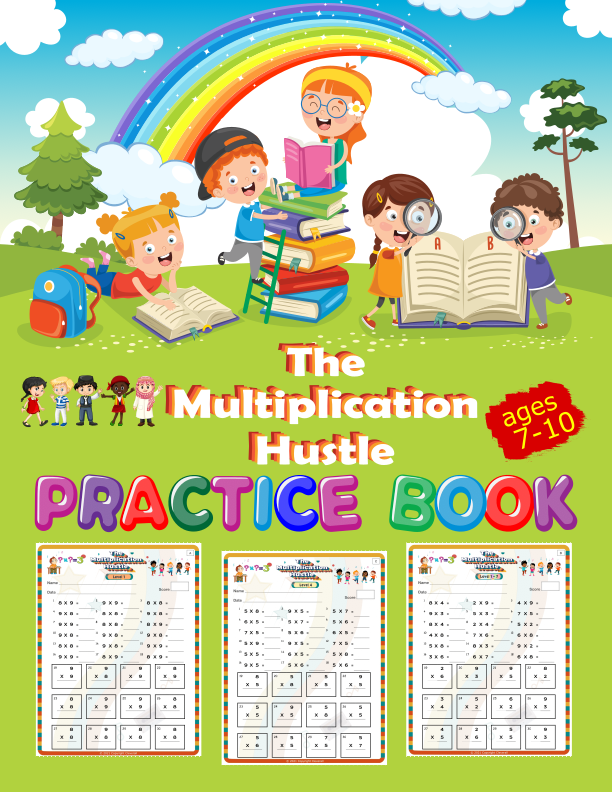
Look at problems 3 and 4. 7 × 8 and 6 × 9 sit near the summit, among the hardest facts in the whole set. The Multiplication Hustle starts there, with 9 × 9 at the summit, so the hardest facts come first instead of last. If you want to see where your class stands before break, our free play-along video runs all 36 facts from the summit down in about three and a half minutes.
More for November
Still working through the fall? Pumpkin Math: 15 Activities That Actually Teach Something has seed counting, arrays, and a farm stand that pair well with the word problems above.
Shopping for the holidays? 25 Best Math and STEM Gifts for Kids Ages 6 to 12 (2026) is sorted by age, and every pick lists the skill it builds and one honest drawback. For the classroom, start with 10 Best Math Manipulatives for Elementary Kids (2026).
TimeTable Express
One more thing before the long weekend.
A few days off is good for everyone. The multiplication facts, however, do not wait for Monday, and a student who is shaky on them in November tends to be further behind by January.
That is why we built TimeTable Express. It starts at the summit with 9 × 9 and uses the commutative property, so students learn roughly half as many facts to know all of them. A few minutes a day is plenty. It runs on iPhone, iPad, or Android, and it is free to try for 7 days.
Try it free on the App StoreTry it free on Google Play
The free Thanksgiving Math Pack is at the top of this post.